Introduction
Runwick is a background-job library for .NET 10 that stores jobs in PostgreSQL, SQLite or Redis and runs them on workers you control.
Runwick is a background-job library for .NET 10. Your app writes a job to a store (PostgreSQL, SQLite or Redis), and a worker picks it up and runs your handler. The worker can run inside your app or in a separate process.
It is a library, not a service. There is no Runwick server to deploy. The store is the single source of truth, and workers never talk to each other: they talk to the store.
How it works
You describe a job and a handler
A job is a plain record with a stable name. A handler is a class that knows what to do with it.
Text Your app dispatches it
Text DispatchAsyncreturns only after the store has confirmed the write.A worker runs it
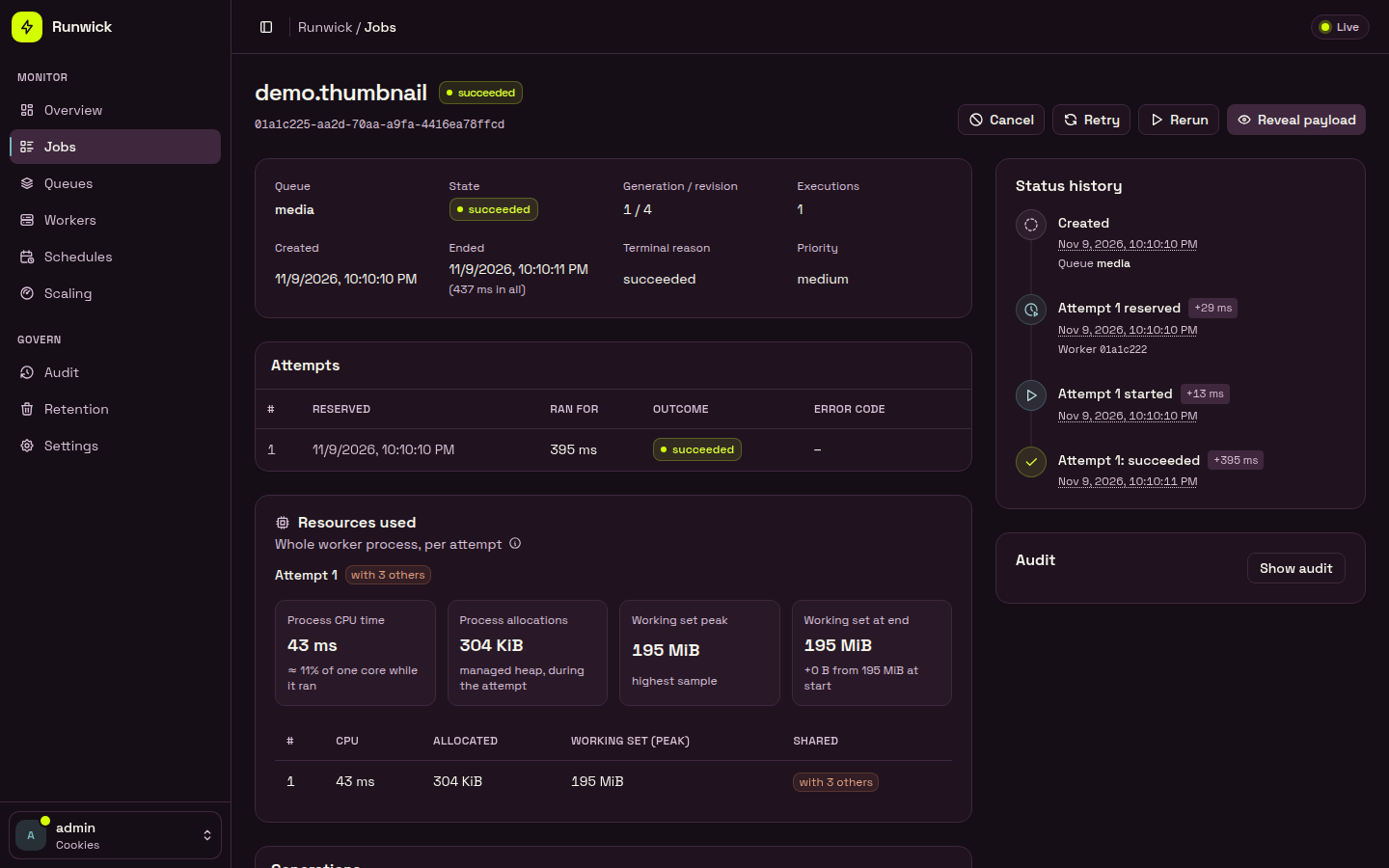
A worker reserves the job from the store, holds a lease on it while it runs, and records the result. If the handler fails and there are attempts left, the job waits for a retry delay and runs again. If it runs out of attempts, it ends up
failed, where an operator can retry it.
Producer, worker, scheduler and management are roles, not separate programs. One process can take any combination of them. See Choosing a store for the common shapes.
What you get
- Three stores, one API. PostgreSQL is the reference store, for many hosts. SQLite suits a single machine. Redis needs one durable primary. Your jobs and handlers do not change between them.
- Retries and timeouts. Each job has an execution budget (3 by default) and an exponential, partly random retry delay. Timeouts are off unless you set one.
- Queues and priorities. Worker pools read named queues with high, medium and low lanes. Queues can be paused.
- Uniqueness, rate limits and concurrency caps. All off until you declare them.
- Schedules. Cron and one-time schedules that create at most one job per occurrence.
- Same-transaction work. On PostgreSQL and SQLite, you can create a job, or complete one, in the same transaction as your own data.
- Transactional outbox. Commit a message with your business data, then deliver it to any store.
- Operations. A management HTTP API, a web dashboard and the
runwickcommand line. All three share the same permissions and audit trail. - Observability. OpenTelemetry traces and metrics, structured logs and health checks.
What it promises, and what it does not
Runwick's guarantees are deliberately narrow, and the docs say so plainly.
- At-least-once delivery. A handler can run more than once: after a crash, a lost lease or a lost reply. Write handlers that are safe to repeat, and pass an idempotency key to outside systems.
- One exactly-once case. If your handler's effect is a change in the same PostgreSQL or SQLite database as Runwick's tables, the change and the job's completion can commit together. Nothing else is exactly-once: not emails, not HTTP calls, not Redis.
- Cooperative cancellation. Cancelling a job signals its
CancellationToken. Runwick cannot stop code that ignores the token. - A lease running out does not prove the old handler stopped. Two copies of a handler can briefly overlap.
- Durable settings are checked, not assumed. Runwick refuses store settings that could lose jobs, such as SQLite without
synchronous=FULLor Redis withoutappendfsync always.
Pre-1.0
The API and storage formats can still change before 1.0. The work to certify the stores for 1.0 (Windows and macOS checks, a reference benchmark and a 24-hour soak test) is not finished, so no store is labelled "certified" yet.
Delivery guarantees has the full list.
Requirements
- .NET 10. Every package targets
net10.0only. - One store: PostgreSQL 16, 17 or 18; a local SQLite file (the engine is bundled); or Redis 8.2 or newer.
- No Node or npm. The dashboard's web files are inside its package.
Next steps
Installation
Pick the packages for your store, install the CLI and create the schema.
Quick start
Go from an empty project to a job that runs, in five steps.
Choosing a store
PostgreSQL, SQLite or Redis: what each supports and where each stops.
Delivery guarantees
What at-least-once means for your handlers, and the one exactly-once case.
Jobs and handlers
Job names, attributes, dependency injection and the job context.
Dashboard
See queues, jobs and workers, and retry or cancel jobs from the browser.